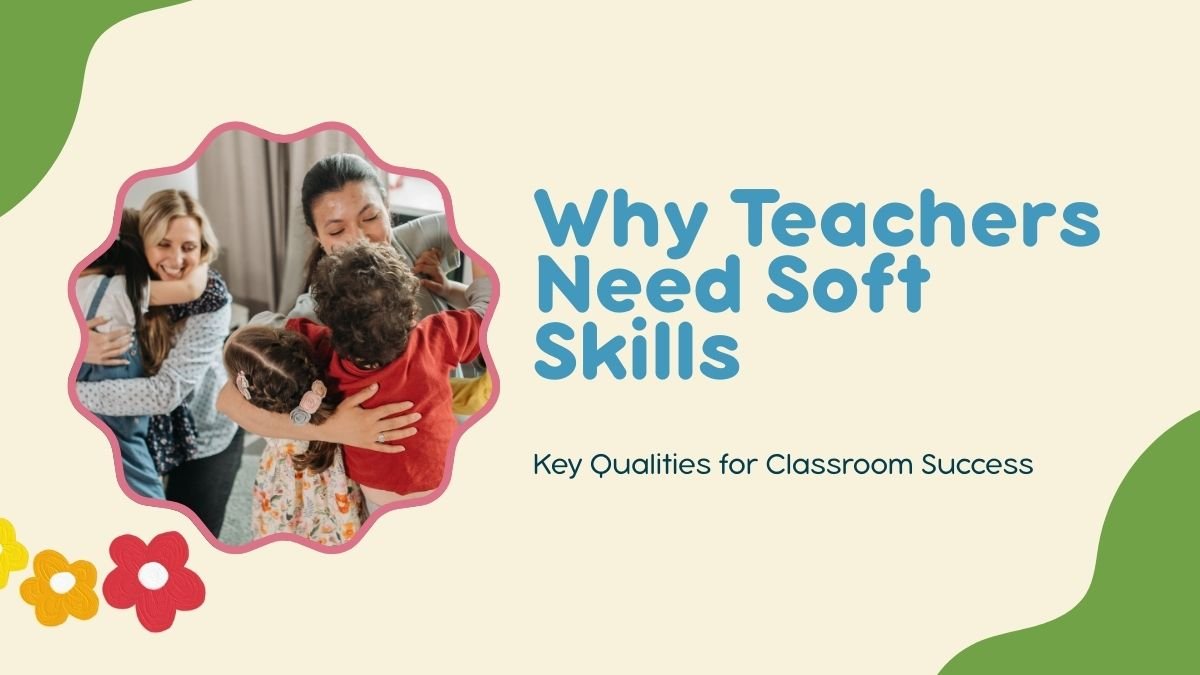
Introduction
Subject knowledge is usually considered to be the main trait in judging good teachers. A mathematics teacher who easily solves difficult problems or a history teacher who creates wonderful links between dates and historical events is considered the best. But the reality is far beyond that.
The teaching role is not only imparting book tidings. True success becomes meaningful when a teacher gets closely connected with students, parents, and colleagues. To reach this understating, the teacher should master soft skills—human, emotional, and behavioral.
These qualities facilitate an active, safe, and inspiring classroom. These soft skills increase children’s self-esteem, motivate them to learn, keep them disciplined, and help them through trying times.
Let us now discuss in detail what other soft skills are significant in teaching and how they distinguish an ordinary teacher from an extraordinary leader.
1. Communication Skills
The single greatest strength in any teacher is the capacity to communicate. Should a teacher teach in a clear, respectful tone, employing simple language, students will listen and participate in class discussions actively.
(a) Active Listening
When the teacher listens to the student actively, the student feels that their problems are being paid attention to.
For example, a student stating: “Madam, I don’t understand this method” – that becomes the cue for the teacher to take that time to explain, thus boosting the confidence of the student.
(b) Giving Clear Instructions
Sometimes, students don’t understand because the method itself is complicated. When the teacher goes through it step-by-step, providing smaller examples along the way, learning becomes much easier.
Say, for example, in teaching a math problem: “First solve this part, and then we will take a look at the next step.”
(c) Construction Feedback
Telling them: “This is wrong” is not enough. The teacher ought to explain why it was wrong and how it might be improved upon next time. This does not frustrate the child but encourages it.
(d) Communication with Parents
A good teacher not only relates with the children but also makes timely contact with the parents. When parents and teachers are in a synergized partnership, the child’s development is accelerated exponentially.
2. Empathy & Emotional Intelligence
The definition of empathy is coming to terms with and feeling for another person’s emotions. This is a vital skill in a teacher.
(a) Making a Safe Place
Children feel safe in a classroom with teachers who understand their problems, especially concerning those with personal difficulties and academic challenges.
(b) A Deep Understanding
In case of child misbehavior, it is important not to go solely on anger rather to investigate the underline cause—stress, difficulty with the subject, or maybe some problems at home.
(c) Connecting with Students
When a teacher connects with children’s emotions, children develop trust and actively participate in their studies.
3. Patience
Teaching is a field of work that absolutely requires patience. Each child is different and so is the speed with which that child learns.
(a) Acceptance of Varying Pace
A few children learn at fast rates while others take time. A patient teacher starts explaining things over and over again till the child finally learns.
(b) Less Stress
The calmer the teacher is, the more calm the children will be; if the teacher is angry, children tend also to be disruptive. Thus, classroom discipline is maintained.
(c) Unexpected Challenges
There are times when the lights go out or the required equipment is not available—a patient teacher quickly tries to resolve such situations.
4. Flexibility & Adaptability
Classrooms are colorful spaces since something new happens every day.
(a) Change in Lesson Plans
If children seem exhausted one day, then instead of lecturing, the teacher should take fun lessons or activities.
(b) Different Learning Styles
Some children learn by seeing, some by listening, and some by doing. A good teacher keeps all those in mind.
(c) Alternate Solutions
If there are no materials for an experiment, the teacher picks another way of demonstrating the same idea for kids immediately.
5. Collaboration and Team Work
Teachers do not work alone; they work within an entire educational system.
(a) With Fellow Teachers
Planning curriculum, resourcing, and brainstorming makes it easy and gives teamwork an edge.
(b) With Students
It is equally the teacher’s job to teach children how to work in teams through group activities and projects, which teach them cooperation and the concept of shared responsibility.
(c) With Parents
When teachers and parents work together and share information about the focus of their child’s progression, it exponentially enhances the child’s development.
6. Conflict Resolution
Once in a while, little disagreements and disputes arise within the classroom. A good teacher knows how to deal with them.
(a) The Faster Conflicts are Resolved
Conflicts that are dealt with quickly do not escalate into larger conflicts.
(b) Unbiased Listening
Teachers need to listen to each side before making a fair decision.
(c) Classroom Management
Managing students by their organized number, participation, and activities significantly minimizes conflict.
7. Leadership and Self-Reflection
A good teacher inspires children, impacts colleagues positively, and assesses themselves at every turn.
Conclusion
It is very clear that subject knowledge will not help alone in the field of education. Other attributes like communication skills, empathy, and soft skills such as patience, flexibility, collaboration, and conflict resolution are equally important.
An accomplished teacher will:
- Listen
- Understand
- Be patient
- Allow every child to progress at his or her speed
- Motivate the child in the end
In this way, a teacher imparts not only bookish knowledge but also life lessons, and this is the true mark of a true teacher.