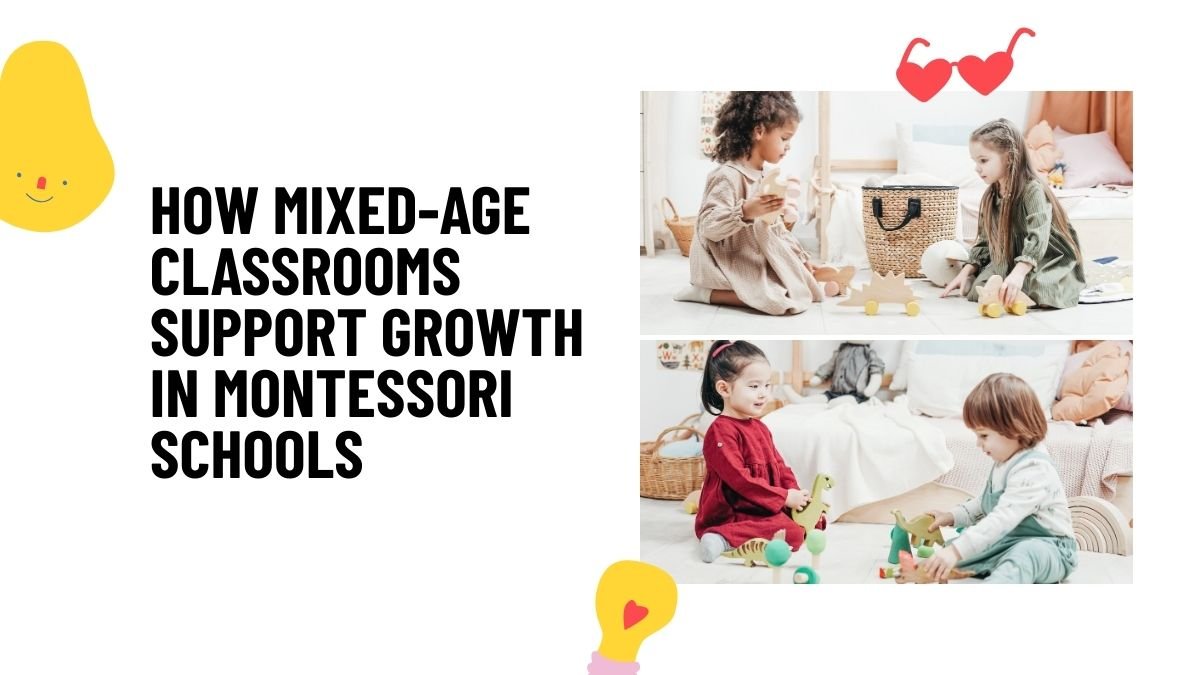
Montessori – Mixed-Age Classrooms: An Environment That Supports and Prepares Children for Life
One of the most evident and popular hallmarks of the Montessori education system is mixed-age classrooms. It is not just a study method, but rather it sets up experiences in life for the child. It allows younger and older children to learn side-by-side, just like at home or in society. This model is vital for helping children strengthen their social development, refine emotional maturity, and even leadership abilities.
As younger children learn from older children and older children guide them down learning paths, the classroom takes on a family-like experience. Every child feels safe, supported, and independent.
For Young Children
1. Observation
Often younger children learn a great deal by simply watching the older children.
- For instance: Suppose the older children in a particular class are creating toys made from clay; younger children start learning how to make shapes bit by bit by watching.
It really is spontaneous, fun, and pressure-free.
2. Exposure to Difficult Ideas and Words
- For instance: Older kids in the class do addition and subtraction mathematics, so younger kids start understanding numbers.
- Learning language becomes applicable as they start to understand words and sentence structures new to them.
3. Safe, Loving, and Nurturing Environment
The presence of older children in a class makes younger children feel safe.
Just like older siblings take care of younger ones in the home, it becomes a family-like environment in the classroom.
Younger children feel help surrounding them, and that gives them confidence in their learning process.
Advantages for Older Children
1. Fortification of Learning
Older children become stronger in their knowledge when they explain things to younger ones.
- Example: Older ones teach younger ones to write letters, and that makes the older ones also remember it well.
2. Development of Leadership Qualities
Older children, by mentoring younger peers, develop patience, self-confidence, and empathy.
Such experience later becomes useful in teamwork or leadership roles.
3. Master of Skills
Teaching others a task is also a way to master the skill themselves.
Whether it is music practice, art, or math problems, older children’s strong hold on a particular skill augments as they teach younger children.
Room Benefits All
1. Teaching Them with No Pressure
In mixed-age classrooms, there is no pressure on children to learn at the same speed.
Each child can learn according to their own capability and time.
The setting becomes supportive rather than competitive.
2. Develops Socio-Emotional Skills
Mixed-age classrooms nurture:
- Negotiation skills
- Compromise
- Conflict resolution
- Respectful emotional expression
3. Reality Check
In real life, you engage with people of different ages.
In mixed-age classrooms, children learn early how to relate with peers and adults, increasing their adaptability.
4. Growth Mindset Development
Children realize that skills develop over time with practice and effort.
This motivates them to work consistently and adopt a lifelong learning attitude.
5. Culture of Working Together
In these classrooms, there is no separation of “older” or “younger.”
- Students collectively engage in projects.
- This builds cooperation, mutual support, and collective responsibility.
Real-Life Example – Montessori Mixed-Classrooms
Arts and Crafts
Older children teach younger ones how to cut paper or color, laying the foundation for art techniques.
Language and Storytelling
Older children tell stories or teach younger ones how to write, helping them build vocabulary and sentence skills.
Mathematics and Logic Activities
Older children engage younger ones in counting, adding, subtracting, or block-building, preparing them for logical thinking.
Social Activities
Younger and older children work together in games or projects, learning shared responsibility, cooperation, and compromise.
Conclusion – A Complete Learning Environment
Montessori mixed-age classrooms provide children with academic knowledge, social values, emotional strength, and leadership qualities.
- Younger children: Watch and learn in a safe environment.
- Older children: Build leadership, patience, and cooperation.
Such an atmosphere fosters cooperative learning, self-reliance, and real-world preparation.
This is why mixed-age classrooms hold a prominent place in Montessori education — developing integrated, independent, and collaborative childhoods.